A "Semi-Custom" Compact Spinnerbait.

The first person that said "You can't have too many choices" must work for a lure manufacturer these days. It seems that every time a new design comes onto the fishing scene and becomes the new "hot" bait, every major lure company comes out with a similar lure. It doesn't matter if it's the Floating Minnow (Rapala) Soft JerkBait (Slug-O, and later Fluke) Suspending Jerkbaits (Rogue and Husky Jerk), or the newer "hot lures" like Swimbaits (soft and hard) , the Senko, or even Wakebaits or Glidebaits, as soon as new lure proves itself imitations are soon to follow. Spinnerbaits have been around long enough that the "new" has long since worn off, but they continue to be such versatile and productive category that every major lure maker has some style of spinnerbait in their offerings, if not several.

Many younger anglers probably don't know spinnerbaits were one of those "hot" lures, but if it's any consolation, it was before my time too. There were other "spinner lures" like the Shannon Twin Spin, but they were more of a cult or regional choice than a phenomenon. Spinnerbaits became such a productive and popular lure that not only does every large lure maker offer several, but there a many custom spinnerbait makers that do a steady business on the premise of everyone has their own idea of what the "perfect" spinnerbait is. So you're thinking "Why tinker with a lure when you can just order whatever odd combination you think is your  "Killer" Spinnerbait?" Maybe you like to tinker, or maybe it's just more convenient to alter a lure you can buy locally for cheap, or maybe you're so picky you can't find the exact one you have your heart set on. All of those reasons are why I like to make a compact spinnerbait from components readily available to me. I still order some special models ready to go, but for a lot of my compact spinnerbait needs I make this one.

WHY COMPACT?
For most of my Bass fishing in either Smallmouth rivers, our smaller lakes, or the White River chain of reservoirs I prefer a compact spinnerbait. I've found the smaller size works as good if not better in almost every situation, the only exception being when heavy rain has both raised the water level and made it murky to downright muddy. Under those conditions the larger presentation of a standard spinnerbait is often a better choice, especially in reservoirs. This isn't set in stone, I use a compact spinnerbait with willow-leaf blades in rivers even if it's muddy, the smaller size and more streamlined blades make controlling the lure around cover in heavy current easier, and sometimes it out-fishes the bigger model in reservoirs, too.  There are many different compact spinnerbaits available, but due to years of fishing these lures I've settled on three things a spinnerbait must have:
IS IT "COMPACT"?
First and foremost is the size. If I want a compact spinnerbait, it better be the right size, that is, "compact". Not teeny-tiny like the Strike King Mini King or the 1/8-ounce Booyah "Pond Magic" or the littlest Stanley Wedge, but no bigger than most company's 1/4-ounce model.
THE HOOK.
The spinnerbait must have a premium hook. Mustad, Gamakatsu, Owner, Matzuo, it really doesn't matter to me as long as it's a good one. I used the Terminator Custom Tungsten spinnerbait for years but was never really happy with the hook Terminator uses on that bait. It's O.K. - but not perfect, especially considering how nice the rest of that particular lure is. Here's the deal on a spinnerbait hook: There's no way to change out the hook on a standard spinnerbait. You simply have to start with a new lure if it's bent or broke beyond straightening or sharpening. So the hook is the heart of a good spinnerbait.
THE DETAILS.
I like a good paint job on the head of the lure. Nice holographic eyes help, too. It probably doesn't make a difference to the fish (and gets chipped and faded after a little use anyway) but I like it. That's one reason why I don't like the War Eagle spinnerbaits as much as most other folks. The plain silver heads look "unfinished" to me. It probably doesn't matter to the fish one bit, but like all fishing, it's a confidence thing. And yes, I know one of my favorite jigs, the Booyah Baby Boo, doesn't have eyes or other details like some other jigs.
Sue me for not being consistently rational.

One spinnerbait I've been using is the Strike King Li'l Mr. Money you can buy at your local mega-store. You know the one. Don't want to buy it there? You can buy basically the same spinnerbait from Bass Pro, but over there it's the Kevin VanDam Spinnerbait, the 3/16-ounce model. It'll set you back a buck more for that one, but they do throw in trailer hook, which doesn't come with the "Mr. Money" version. Either way, the compact size is great, the hook is a good one, and the paint job on the head is pretty good. I buy the one from the mega-store because I like a couple of different aftermarket blades better than the stock one that comes on the VanDam model, and the one dollar savings more than pays for the aftermarket spinner blade I've been using.

Even that has a wrinkle though - the willow leaf spinner blades I've been using come from Bass Pro, so it's ironic that I don't buy their version of the same spinnerbait at that store, but I do go there to get the spinner blades to put on that same lure bought somewhere else. All good fly tiers and tackle tinkerers know this drill. It may not make sense to the outside observer, but by God, you are going to get what you want, even if you seem to be way too picky in the pursuit of fish you will let go after catching them on a lure you obsessed about making.

First, a look at the stock "straight-out-of-the-package" view of this lure
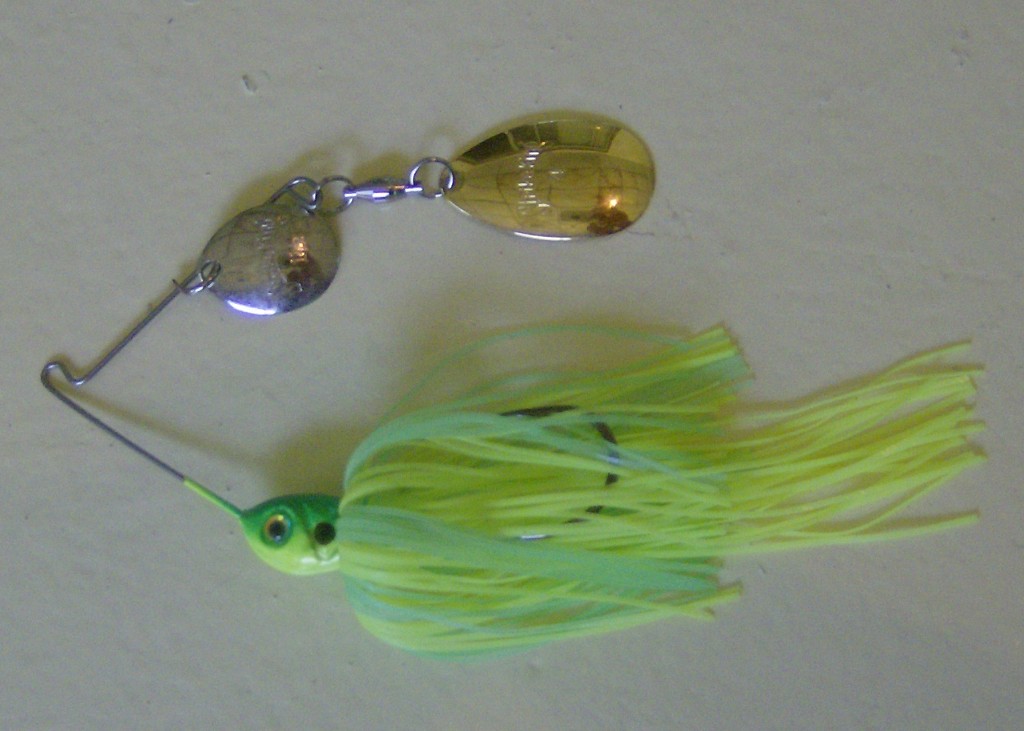
The stock 'Li'l Mr. Money"
You'll need lead wire, or thin (non-rosen core!) solder. A little super glue is a must, also. A pair of split ring pliers are nice, but anything from needle-nose pliers to your trusty Swiss Army knife will work in a pinch. Last, but not least, you need a replacement blade, I like the XPS Custom Willow Leaf blades, in the #3.5 and #4 sizes.
First, I change the blade out, this one is getting the bigger #4 size.

The replacement blade adds more flash.
Then you wrap the lead wire around the hook shank. A fly/jig tying vice is nice, but not necessary.
Wrapping the lead around the hook shank.
You can add underwraps of fly tying or rod building thread to the hook for a better foundation, but I mostly don't.

Coat the wraps with the super glue, and let it dry for at least several hours, and overnight is better. You're done! Now about trailers. This lure comes with the "super skirt" or "tux-and-tails" type skirt that the tackle companies often say eliminates the need for a trailer. Now, I like a trailer, specifically a curly tailed grub in an appropriate size and color. Whatever trailer you like to use, the lead wire wrapped around the hook shank makes sliding it in place a little tough. You have to use a little water as a lubricant to slide it over the lead without ripping it. Then when it fits well enough, a tiny dab of super glue will help hold it in place. I know someone who uses a small hollow punch to "core" their plastics in cases like this, but I'm not that particular. I do like a good trailer, I mostly use Kalin 5" grubs, but have used others, like the discontinued XPS realistic grubs Bass Pro used to sell. I stocked up, so I have a few if I want to use them for some contrast.
The completed spinnerbait.

I used to get Terminator Willow blades from Cabelas, and although I like their unique shape and "thump", they had a tendency to fall down around the hook, skirt, and trailer right at the beginning of the retrieve. This would sometimes ruin a perfectly executed cast by not spinning correctly due to getting caught in the skirt and need a sharp pull to get it spinning. The larger #4 XPS blade has done that to me occasionally, but not to the extent that the Terminator blades did. It's worth using the bigger blade, even with the hassles - it just flat out catches fish! The combination of compact size with the added weight and willow blade allows a very fast retrieve, which most of the time gets more reaction strikes in our clearer water.
As for colors, I like white anytime, murky water or clear, but let the fish tell you what they want. I use firetiger mostly in off color water, and lean toward white/silver baitfish colors in clear water, but for Smallmouths in current, I think the hotter colors work best, with all white coming in second.
What kind of tackle do I use to throw this little beauty? It's basic casting gear, a medium action rod (usually 7') and a high speed retrieve reel spooled with 10/40 Stren Superbraid. I got a good deal on a big spool of it, and it works, what can I say. I use the Uni knot to tie it direct to the end of my braid, but I go around the wire of the spinnerbait twice before making the Uni Knot, like is shown HERE at the PowerPro.com home page.
There's some guy trying to claim he invented this knot and is calling it the "Fish'n Fool" knot. I've used it on braided line about forever, so "Fool" is an apt title for this guy. Anyway, that's about it. There's my super-secret fish catchin' compact spinnerbait. Until I find another one I like better.

Comfortable Wet Wading.

During the Summer months most fishermen want to ditch their hot, bulky waders and "get wet". It doesn't matter if it's a walk-and-wade trip or when you get out of the canoe, kayak, "White River Slim" or drift boat to cover some fishy looking water more effectively; Everyone wants to go as simple as possible (and stay cool) during those hottest days of the year. If you haven't done it you may not know many times wet wading can be just as uncomfortable as hot and sweaty waders if you aren't prepared with the right gear. So, starting at the top, here are some ideas about the selection of clothing and gear that will help keep you cool, comfortable, and more focused to catch more fish in the heat of Summer.

Hats
Many fishermen wear simple baseball style caps that perform pretty well, but they sure don't keep the sun off of the back of the neck. The flats style cap, with the sun flap in the rear is a much better choice, as is any style of full brim hat from the “boonie” jungle type to the Stetson. A hat that blocks the sun and is lightweight can keep you much cooler. A darker color under the brim keeps sunlight reflected off the water from, in turn, reflecting off the underside of the brim into your eyes. For the past few seasons I've been wearing a Stetson style hat with a ventilated crown. It's cooler than the cotton baseball caps I used to wear and it also looks better, if that's something you care about. If you fish in windy conditions, try to find a hat with a chinstrap. This may sound and look a little funny until the wind blows your favorite hat off your head and into the main current of the river never to be seen again! One trick I learned to deal with nasty biting insects is to spray a little insect repellent on your hat. This keeps insects away from your head ( and ears where they're most likely to drive you nuts) and repellent off your fly line when you wipe sweat off your brow and then touch your line again. Sure, it sounds funny until you see how well it works, but be careful with your nice Tilley or any kind of hat made of nylon, as the chemical that repels insects (DEET) can damage the material.

Shirts
There's a large majority of people who wear T-shirts in warm weather, period. But if you wear a fishing vest on over a shirt with no collar it can rub the back of your neck or pull your shirt back, leaving you with a nice sunburned area at the end of the day. A good hot-weather collared shirt that is lightweight is not hard to come by, either polo style or button down. One of my favorite materials for hot weather is good old Madras cotton, but many new “technical” breathable fabrics, such as Supplex, are available. Short sleeves are very comfortable, but sunscreen is messy and I prefer to roll sleeves up or down as the day goes on. Believe it or not, if there's a breeze long sleeves with a breathable fabric can be cooler than letting the sun bake your skin, not to mention avoiding the risks of long term sun exposure. Whatever you choose, it should be light colored, like khaki or a very light green. There are some newer colors that might be "fashionable" and look better in your "hero shots" but are more of a fish-scaring tone than plane sage green or khaki tends to be. Chose yours wisely.

Vests and PFD's
Face it, we just don't wear our PFD's as often as we should, and another item of clothing insulating you when the heat index is above 100-degrees is uncomfortable, but there are alternatives. There are mesh PFD's, but the coolest you're likely to find are the strap-type self inflatables. I have to invest in one of these, I don't wear my PFD as often as I should when fishing out of my solo Canoe in warm weather because conventional PFD's are so hot. This would solve that problem. Do you ditch the PFD when you drop over the side of the boat and start wading? I don't know, there are probably good reasons to keep it on when wading faster water, but I don't like to wear it if I'm in a few inches of water, but make your own mind up about that.

Most of the time a vest is a necessity to carry all the gear us wading fishermen will use (or think we will), but anything extra you wear when it is 95 degrees out is going to make you suffer. A small fanny pack or similar tackle bag will keep you much cooler. Remember that something in a tackle bag around your waist will get wet when in an upper pocket of a vest it would not. (Unless you take a dunk.) In other words, don't carry gear you don't want wet where it will get wet. A small waterproof zip-lock bag (or dry-bag) will keep your wallet and phone dry. I suffer a little, but I usually wear a vest on strictly walk-and-wade trips, but it is a lightweight, mesh vest. No matter what method you choose to carry your gear, pack a good amount of water in it to last the day. Dying of thirst tends to be distracting!


Pants or Shorts
O.K., I'll admit I'm not really a shorts person, but when it's really baking outside, even the lightest pants feel hot. So, on rivers I know well I'll show some leg. The disadvantage of shorts is that if you have any amount of bank side scrambling to do, you can get insect covered and scratched from vegetation easily, and ticks have an unrestricted highway right to your 'nethers.
Can you say "Poison ivy" or "Honey, can you help me get this tick out of my @#&"?
Even light, Supplex pants will protect you from that. So, on rivers that are not really familiar, I stick to pants. If I do walk the banks for a short time and get right back in the water, it seems that the ticks and other insects don't have a chance to take hold. Old blue jeans sound good, but when wet are heavy enough to sink the Titanic, and uncomfortable to boot. Light weight khaki's are pretty good, and poplin or other light common fabrics hold up well, but none are as light weight and comfortable as Supplex. Some pants have zip off legs that convert them to shorts. My thoughts are that some people will lose one leg, or if you are like me a zipper will stick on you at the worst time. Pick one or the other. Pants that have regular waistbands tend to stretch when wet. A little elastic help keep them up, and keep your shirt tucked in, too.

Underwear
Yes, I am really going to talk about this. Regular cotton underwear stretches when wet and holds moisture near your skin. It can be aggravating. Some shorts and pants that are meant for wet wading have a built in brief. Bass Pro's World Wide Sportsman, Columbia, and Cabela's Guidewear line are my favorites. I like these a lot, it would depend on if they were comfortable to you. If you like “boxers”, probably not. Underwear that is made for high performance athletes such as triathlon competitors that get really wet and sweaty may be an answer. Whatever you do, don't deal with irritating and uncomfortable underwear. Find something else.

Wading shoes
The wading shoes you have now may be all you need, but if you have wading shoes sized to go over heavy stockingfoot waders they are probably too big. A separate pair may be the only answer. I have worn many pairs of old hikers as wading shoes and this worked because the rivers I fish mostly have mixed gravel bottoms, not solid rock. If you need a felt sole you will have to go the regular wading shoe route. I have tried the wading sandals but found them really painful when small rocks get trapped between your foot and the sandals foot bed. This seems to happen every other step! If your rivers have no small rocks you may find them perfect. If your wet wading also involves lots of hiking, you will want more support than the typical wading shoe, and more dry land traction. L.L. Bean was the first to offer a line of shoes with a new type of rubber sole that grip well on slick rocks, but also allows a better grip on slick grass and leaves on the trail. There are many more brands out there today due to many areas banning felt soles due to the percieved greater chance of spreading "Whirling Disease" (Myxobolus cerebralis). For slick, solid rock, I don't think anything will ever beat the grip of felt, but felt soles have led to various "falling down the bank" incidents once on wet grass or mud for me. So any of the newer rubber soles might be the best compromise, and give me an excuse to leave my old hikers on dry land. I think socks are expendable. This is where the ones you are going to toss in the rag pile come in handy. If you use new ones, by the end of the day, they will be shot anyway.


As with all fishing, there are other things to consider and all are common sense. Keep drinking water at regular intervals. Usually you don't get thirsty until you are a little dehydrated. Take some dry clothing to change into for the ride home. Even in the heat clean, dry clothes really make you feel refreshed. Some people simply cannot take the heat. If you are one, you may find that only going out early or late in the evening is bearable. Most of the best fishing is early or late in summer anyway. You don't have to flog the water at noon on a day that's 100 degrees. If you want to, well, I guess that's fine. Usually during that time of day, even I take a break.

A Simple System For Smallmouths

I was re-reading In-Fisherman magazine Editor Doug Stange's system for pre-spawn Smallmouths because recently I was watching the re-run of the In-Fisherman Critical Concepts episode that had a segment based off that article. Here’s his system: 4 spinning rods, two with Rapala X-Rap jerkbaits in sizes 8 and 10, and two rods rigged with a plain jig head for curly tailed grubs, again in two different sizes. The whole key was to throw the larger jerkbait or grub, and using the smaller baits to clean up after catching a few, or throw back at a fish that followed but wouldn’t commit. Maybe drop the smaller grub by a large boulder or tree to entice an inactive fish you suspect is lurking there. His method is probably mostly applied to Canadian Shield Glacial lakes near the In-Fisherman main office there in Minnesota.

This got me thinking about how my river Smallmouth tackle has evolved over the years. I didn’t set out to get a “system” or be super sophisticated about things, this is just what works for me when fishing out of my solo canoe. Some of the basic idea here is blatantly ripped off from Al Agnew, who is known for carrying half a dozen rods when fishing out of his solo canoe. I don't know when I first read about his set-up, but it sure gave me a starting point when I got my first solo canoe. I think where my fishing style diverges from his is not only do I use several rods rigged and ready to go, but most of the rods are set up to change lure styles on them easily, too.
I use several rods rigged in ways that make it easy to change lures quickly.
The first is a medium to medium/light power, fast action 7’ spinning rod for treble hooked lures. It’s paired with a larger capacity spinning reel spooled with 4/10 Fireline, and I use Fluorocarbon leaders of 8- 10- or 12-pound test, except for top water lures, then the leaders are almost always 10-pound monofilament. I’m mostly using a Blood Knot to tie my leaders to the main line these days. Sometimes I double the end of the Fireline with a Spider-Hitch before maing the Blood Knot with the heavier pound-test lines.
This rod is for jerkbaits, topwaters, and a whole array of crankbaits. Treble hooked lures, like I said. Read about why I like this set-up for crankbaits in particular here: River Crankin' Smallmouth.
I sometimes also use this rod to present a spoon or in-line spinner. I use a plain snap (Not a swivel-snap) in one of the middle sizes on the end of the line, and remove the split rings from the lures. I can change lures in seconds using the snap, and I think I get more action using the snap. I save the split rings for other uses. I don't have to buy many split rings.
http://www.basspro.com/webapp/wcs/stores/servlet/Product_10151_-1_10001_7816_100010005_100000000_100010000_100-10-5
I was going to post a picture of dozens of different cranks and jerkbaits here, but you get the idea.
There are a couple of cranks that are hard to connect with the snap like the new XRap Shad and the Fat Free Shad series due to their lip design, on these lures use pliers or a hemostat to make working the snap through the eye easier.
The second rod is usually about the same length and power, rigged with a simple jighead. I like one with a single strand weedguard, and depending on current either 1/16- or 1/8-ounce. I’m really liking the E. C. Jigs available at BassPro.com, which uses the awesome Matzuo Sickle hook. I’ve never had a fish come off after getting this hook in them. You can use a 4- or 5-inch grub, an action-tail worm (try Zooms “Shaky Tail“) in place of a grub, or just a plain straight tail finesse worm for use as a Shaky Head. Another great trick is to use this jig head to wacky rig a soft stick like the Yum Dinger or Yamamoto Senko, or just wacky rig a plain straight tail worm. A smaller tube works well on this jighead, too. You can see it’s simple to change this one to fit different conditions pretty quick, too. If the fish are really on the Shaky Head , I will change the jighead out for a weedless one, but this one is a better starting point.

E.C. Jigs jigheads rigged with a 4” Yum Dinger (wacky-rigged), Zoom Shaky Tail, and Kalin 5” Grub,
Plain 1/8-ounce head in foreground.

The third quick change option is a rod with a little more backbone, the same length as the other two, but maybe a medium/heavy power, or at least an extra-fast medium powered rod paired with the reel spooled with 6/14 Fireline. I’ll use heavier leaders for this set-up, sometimes 14-pound test Fluorocarbon, but usually 12-pound.  At any rate, on the business end of the leader, it has a extra wide gape 3/0 or 4/0 hook. That’s it.

From top down: Matzuo Sickle. Gamakatsu Wide Gap. weighted Mustad. Gamakatsu weighted w/fly tying lead wire.

You can rig a soft jerkbait like the Super Fluke or the Powerbait JerkShad, any of the soft stick baits, or even larger tubes or other soft plastics, like the Yamamoto Ika, which sinks well without any added weight.

Left top: Stik O, Tiki-Stik, Dinger. Top right: Culprit Jerk Worm, Z Too, Fluke.
Bottom: Home poured Ika imitation, Strike King tube, XPS tube.
Tubes can be rigged weightless, or you can quickly slide a small bullet weight inside, point first, to get a longer cast and quicker fall. Try a 1/16-ounce weight in water up to about 6-foot deep, and 1/8-ounce for deeper water or more current.

You can insert a bullet weight to quickly change fall rate.

Floating worms are another overlooked option that is still a killer. Does anyone use them anymore? I do, especially as a substitute for soft jerkbaits, especially in the post-spawn time of the year. If I’m using any of these lures faster (which I usually do at first) and not getting any response, I let the lure fall beside a piece of cover, and if that works I’ll often change the wide gap worm hook out to a weedless wire guard model, and switch to wacky-rigging a soft stickbait like the Yum Dinger or Wave Worm Tiki-Stick, but I’ll try several different colors and types of lures on the wide-gap hook first, because it’s so easy to switch them out. Don’t forget to try a standard straight-tailed worm wacky rigged, either. I like the Zoom Trick Worm for Smallmouths. It seems a little big at first, but it’s a slim worm over all, so don’t think it’s too big. The best place to hook this worm for wacky rigging is right behind its “egg sack”. It’ll look a little off balance hooked like that, but try it anyway.


Left: For comparison, soft stick baits, from top. Stik O, Senko, Tiki-Stik, Dinger.
Right: Zoom Trick Worm in three colors, XPS finesse, PowerBait Shaky Tail, and Senko Slim

These aren’t the only rods I carry Smallmouth fishing, I usually have a dedicated spinnerbait rod, and often one just for finesse jigs. This changes depending on season, in the low clear water of late summer, I might ditch the spinnerbait rod and throw in a fly rod, or a favorite spinning rig just for topwaters.
In winter there will be a rod rigged for a slip float for float and fly and one for nothing but suspending jerkbaits. Often the jerkbait rod is the same one I use for cranks and jerkbaits in summer. I have been carrying one rod dedicated to a swimming jig that is still kind of secret, and in the prototype phase, instead of the jig rod some trips. It could also be fished on my spinnerbait rod, so maybe there’s another twist on that in the future. It’s an evolving thing, and maybe in a year or two there will be other new ways I’m doing things.